

DNA, RNA and central dogma
Page publiée le 29/12/2025 par JBoscq
Today, DNA is recognized as the genetic material present in all cells. It is inherited from parents and plays a central role in determining an individual’s characteristics. The identification of DNA as the carrier of genetic information was a major milestone in molecular biology.
DNA (deoxyribonucleic acid) contains genes, which are sequences of nucleotides carrying the instructions for protein synthesis. But how can a single molecule control the diversity of traits observed in an organism? The answer lies in proteins. Proteins determine the structure and function of cells, and their specific role depends on their three-dimensional structure. This structure is determined by the precise sequence of amino acids, which is directly encoded in DNA.
Vocabulary target:
central dogma of molecular biology, codon, editing, elongation, exon, genetic code, initiation, intron, messenger RNA (mRNA), splicing,
I- The concept of Central Dogma
DNA is organized into chromosomes. In eukaryotic cells, these chromosomes are confined to the nucleus, whereas proteins are synthesized at ribosomes located in the cytoplasm. This raises a key question: how does the genetic information stored in DNA reach the site of protein synthesis?

The transfer of information is ensured by another nucleic acid: RNA (ribonucleic acid). RNA is a relatively small and flexible molecule that can pass through nuclear pores. It carries a copy of the genetic information from DNA in the nucleus to ribosomes in the cytoplasm, where it participates in the assembly of proteins.
In summary, the flow of genetic information follows a precise sequence:
DNA → RNA → Protein
The discovery of this ordered flow of information was a major milestone in molecular biology. It is known as the central dogma of molecular biology, a term introduced by Francis Crick to emphasize the central and fundamental role of this concept in understanding how genetic information is expressed in cells.
II- What is RNA?
A- Why RNA Is Necessary
DNA alone cannot directly instruct cells to synthesize proteins. Although it contains all genetic information, DNA remains confined to the nucleus, while protein synthesis occurs in the cytoplasm at ribosomes. Therefore, an intermediary molecule is required to transfer genetic information from the nucleus to the cytoplasm.
RNA plays this essential role. As a key component of the central dogma of molecular biology, RNA acts as the link between DNA and protein synthesis.
B- RNA versus DNA
Like DNA, RNA is a nucleic acid composed of nucleotides. However, RNA differs from DNA in several important ways. RNA molecules are generally smaller and more flexible than DNA molecules. In addition:
- RNA is single-stranded, whereas DNA is double-stranded,
- RNA contains the nitrogenous base uracil (U) instead of thymine,
- RNA contains the sugar ribose instead of deoxyribose.
These structural differences allow RNA to be well suited for its role in gene expression.
C- Types of RNA Involved in Protein Synthesis
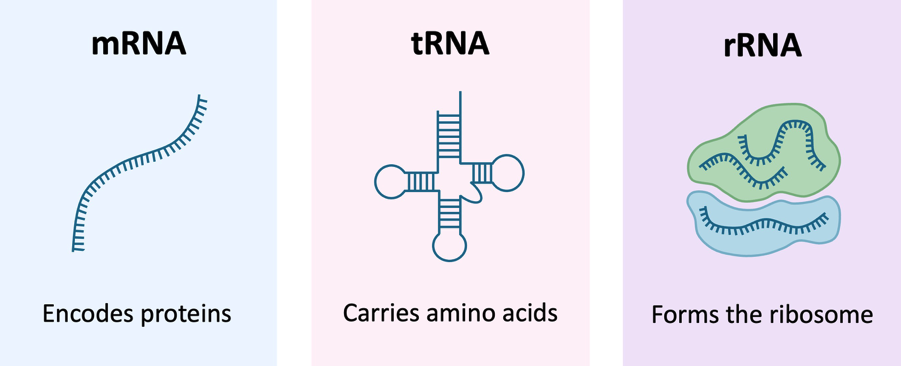
Three main types of RNA are involved in protein synthesis, each with a specific function:
1. Messenger RNA (mRNA) carries a copy of genetic information from DNA in the nucleus to ribosomes in the cytoplasm.
2. Ribosomal RNA (rRNA) is a major structural and functional component of ribosomes, where proteins are assembled.
3. Transfer RNA (tRNA) transports amino acids to the ribosome and ensures they are assembled in the correct order to form a protein.
III- The proteinSynthesis
1- What is the point?
Protein synthesis is a two-step process involving transcription and translation.
Transcription takes place in the nucleus, where DNA serves as a template to produce a messenger RNA (mRNA) molecule. Once synthesized, mRNA exits the nucleus and moves to a ribosome in the cytoplasm.
At the ribosome, translation occurs. During this step, the genetic information carried by mRNA is read and converted into a protein by assembling amino acids in the correct order. Proteins are the molecular tools that make living organisms function.
2- Transcription
The term transcription refers to the process of copying genetic information. During transcription, the information stored in DNA is transferred into a complementary RNA molecule that can be used by the cell.
DNA → RNA
Transcription is the first stage of the central dogma of molecular biology (DNA → RNA). It involves the synthesis of a strand of mRNA that is complementary to one strand of DNA, allowing genetic instructions to be conveyed from the nucleus to the cytoplasm.
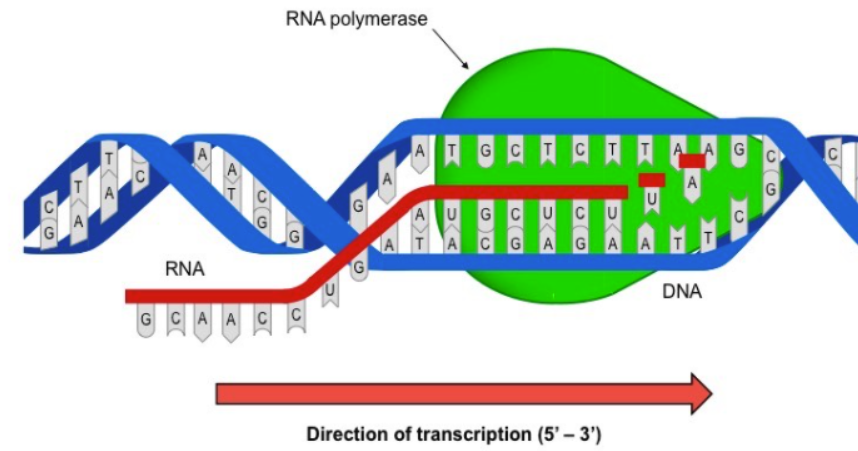
3- Mechanism of transcription
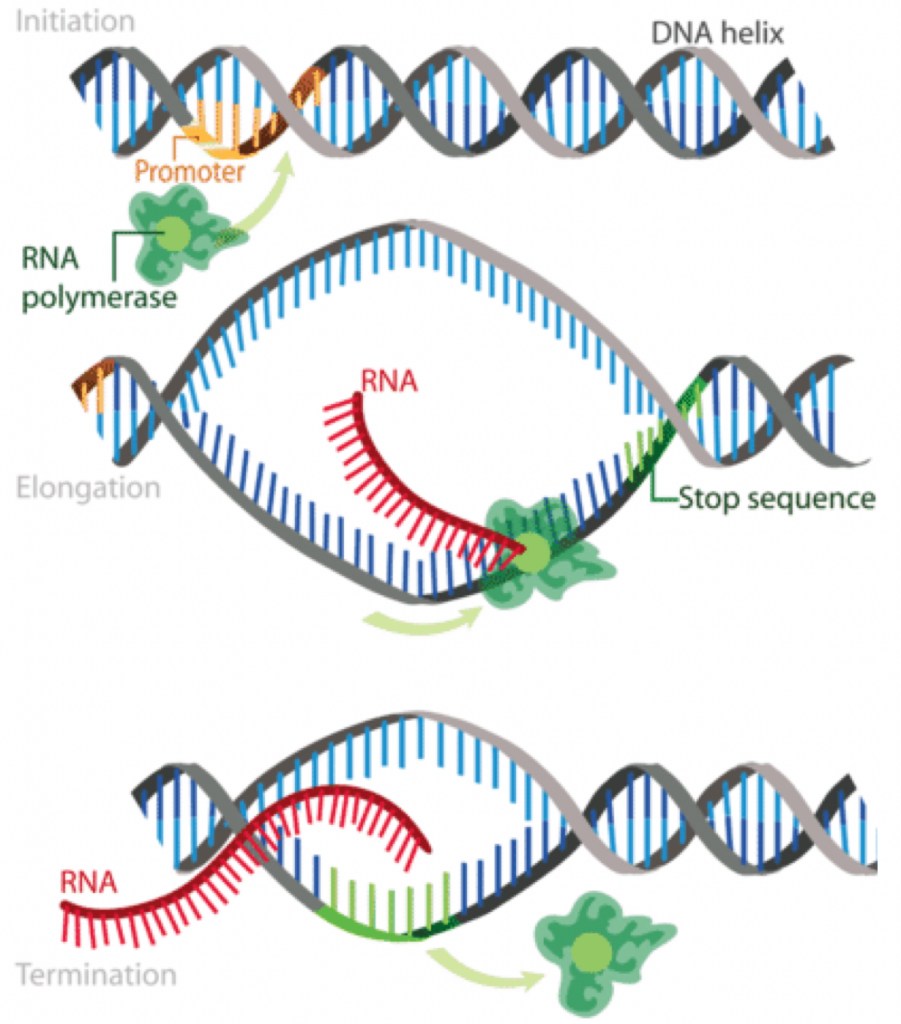
Transcription occurs in three main stages: initiation, elongation, and termination.
Initiation Transcription initiation occurs when RNA polymerase binds to the promoter, opens the DNA, and starts RNA synthesis at the start site.
Elongation corresponds to the progressive addition of RNA nucleotides. As RNA polymerase moves along the DNA template strand, it builds the mRNA molecule by adding complementary nucleotides, extending the mRNA strand.
Termination is the final stage of transcription. It occurs when RNA polymerase reaches a termination sequence in the gene. At this point, transcription stops, the mRNA molecule is fully synthesized, and it detaches from the DNA template. marks the beginning of transcription. It starts when the enzyme RNA polymerase binds to a specific DNA sequence called the promoter. This binding causes the DNA double helix to unwind, allowing RNA polymerase to read one of the DNA strands. The enzyme is then able to begin synthesizing an mRNA strand with a complementary sequence of nucleotides.
4- mRNA Processing in Eukaryotic Cells

In eukaryotic cells, newly synthesized mRNA is not immediately functional. Before it can be translated, it must undergo several processing steps in the nucleus. These modifications ensure the stability of mRNA and regulate gene expression.
The main processing steps include splicing and polyadenylation.
Splicing removes non-coding regions called introns from the pre-mRNA. The remaining coding regions, known as exons, are then joined together to form a mature mRNA molecule.
Polyadenylation involves the addition of a poly-A tail, a sequence of adenine nucleotides, to the end of the mRNA. This tail signals the end of the mRNA molecule, facilitates its export from the nucleus, and protects it from enzymatic degradation.

IV- The Genetic Code
The genetic code is based on the sequence of nitrogenous bases (A, C, G, and U) in an RNA molecule. These four bases act as the “letters” of the genetic code. They are read in groups of three nucleotides, called codons.
Each codon encodes a specific amino acid or a signal involved in protein synthesis. Proteins are made of 20 common amino acids, while there are 64 possible codons, which explains why several codons can code for the same amino acid.
The right order to read the codon
RNA carries the instructions for protein synthesis. Ribosomes read these instructions to assemble amino acids into a polypeptide chain, which later folds into a functional protein.
To determine which amino acids are specified by an RNA sequence, scientists use a codon chart. Each group of three RNA bases forms one codon, and each codon codes for only one amino acid.
To read a codon chart:
- the first base of the codon is read on the left side,
- the second base is read at the top,
- the third base is read on the right side.
The point where these three bases intersect indicates the amino acid encoded by the codon.
Using the GeneticCode
The codon AUG codes for the amino acid methionine. It also serves as the start codon, marking the beginning of translation. This start codon defines the reading frame, which determines how the mRNA sequence is divided into successive codons.
After the start codon, the ribosome reads the mRNA sequence codon by codon. Translation continues until a stop codon is reached. The three stop codons (UAA, UAG, and UGA) do not code for any amino acids and signal the end of protein synthesis.
Characteristics of the GeneticCode
The genetic code has a number of important characteristics.
- It is universal: almost all living organisms use the same genetic code, indicating a common evolutionary origin.
- It is unambiguous: each codon specifies only one amino acid or one signal.
- It is redundant: most amino acids are encoded by more than one codon.

V- From RNA to Protein : translation
Translation is the second step of the central dogma of molecular biology (RNA → Protein). After mRNA leaves the nucleus, it binds to a ribosome composed of rRNA and proteins.
The ribosome reads the sequence of codons along the mRNA. Transfer RNA (tRNA) molecules carry amino acids to the ribosome. Each tRNA has an anticodon that is complementary to a specific mRNA codon.
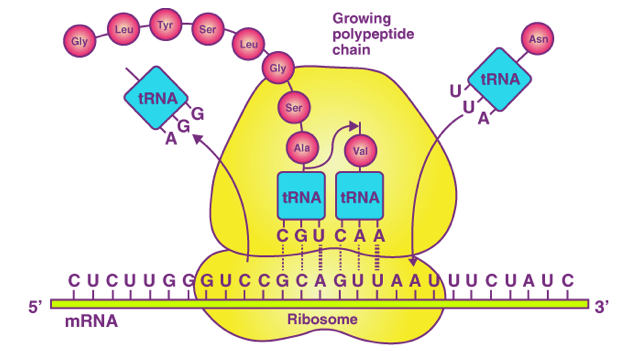
For example, the amino acid lysine is encoded by the codon AAG. A tRNA molecule carrying lysine has the complementary anticodon UUC. When the codon AAG appears on the mRNA, the corresponding tRNA binds temporarily, releases its amino acid, and then detaches. As this process repeats, amino acids are linked together, forming a polypeptide chain. Translation ends when a stop codon is reached.
After synthesis, a polypeptide chain is not immediately functional. It folds into a specific three-dimensional shape due to interactions between its amino acids. Some proteins may associate with other polypeptides or bind to molecules such as lipids or carbohydrates.

Many proteins are further modified in the Golgi apparatus, where they are processed and prepared to perform their specific cellular functions
To help you to better understand : https://learn.genetics.utah.edu/content/basics/txtl/